Why You Can't Stop Scrolling and How We Can Actually Break Free
Short-video apps are built around fast reward loops. Breakly is built around a gentler interruption: short pauses that are easy to accept, long pauses that help you reset.
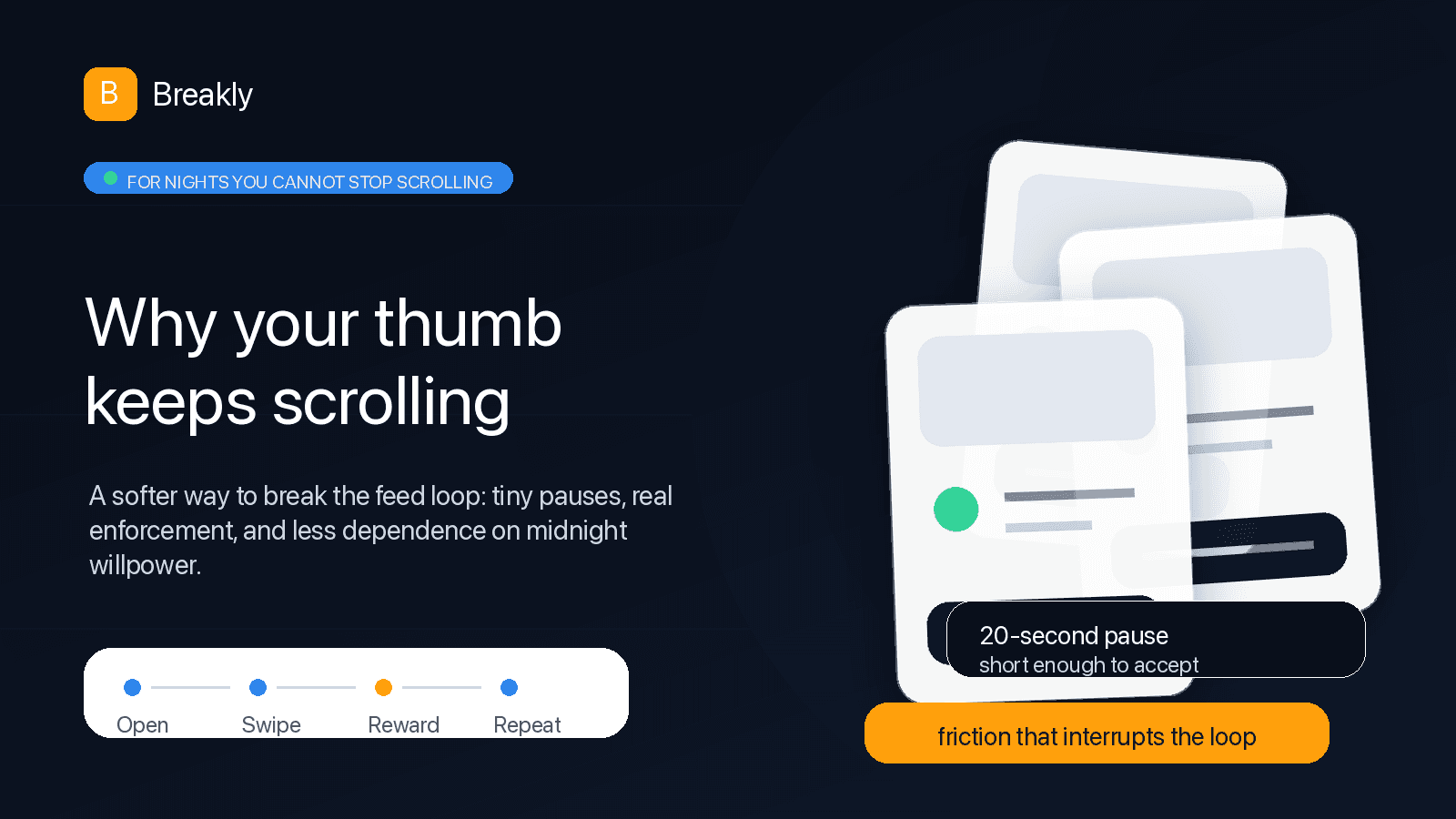
Why You Can't Stop Scrolling
It happens to all of us. You unlock your phone just to check a message, and suddenly, you are completely mesmerized by a continuous stream of short videos. Whether it's TikTok, Instagram Reels, or YouTube Shorts, these platforms are engineered with a casino-like reward mechanism. Every swipe delivers a micro-dose of dopamine, trapping us in a loop of instant gratification. Before you know it, an hour has vanished.
This is not just a personal weakness. Research on smartphone habits has described repeated checking as brief, repetitive inspection of dynamic content, reinforced by quickly accessible informational rewards (Oulasvirta et al., 2012).
We know it's a problem, yet we simply cannot stop scrolling. Why?
The Screen Time App Paradox
In an attempt to regain control, many of us turn to screen time limiters and focus apps like Opal. These tools often rely on positive reinforcement or strict daily time budgets to encourage us to put our devices down.
However, they all share a fatal flaw: they are far too easy to disable. With just a few taps, you can simply turn off the restrictions entirely without facing any real consequences.
This creates a massive psychological paradox: For these apps to work, you must have a strong sense of self-control. But a lack of self-control is exactly why you downloaded them in the first place. It is a vicious cycle. To make matters worse, the intense dopamine stimulation from binge-watching short videos actively depletes whatever willpower you have left.
Behavioral science often describes this as a commitment problem: the decision you make before temptation arrives is different from the decision you make inside the tempting moment. Commitment devices work by making the earlier decision harder to casually reverse (Rogers, Milkman, and Volpp, 2014).
For someone with fragile self-discipline, traditional app blockers are practically useless. So, how do we break the algorithm's spell?
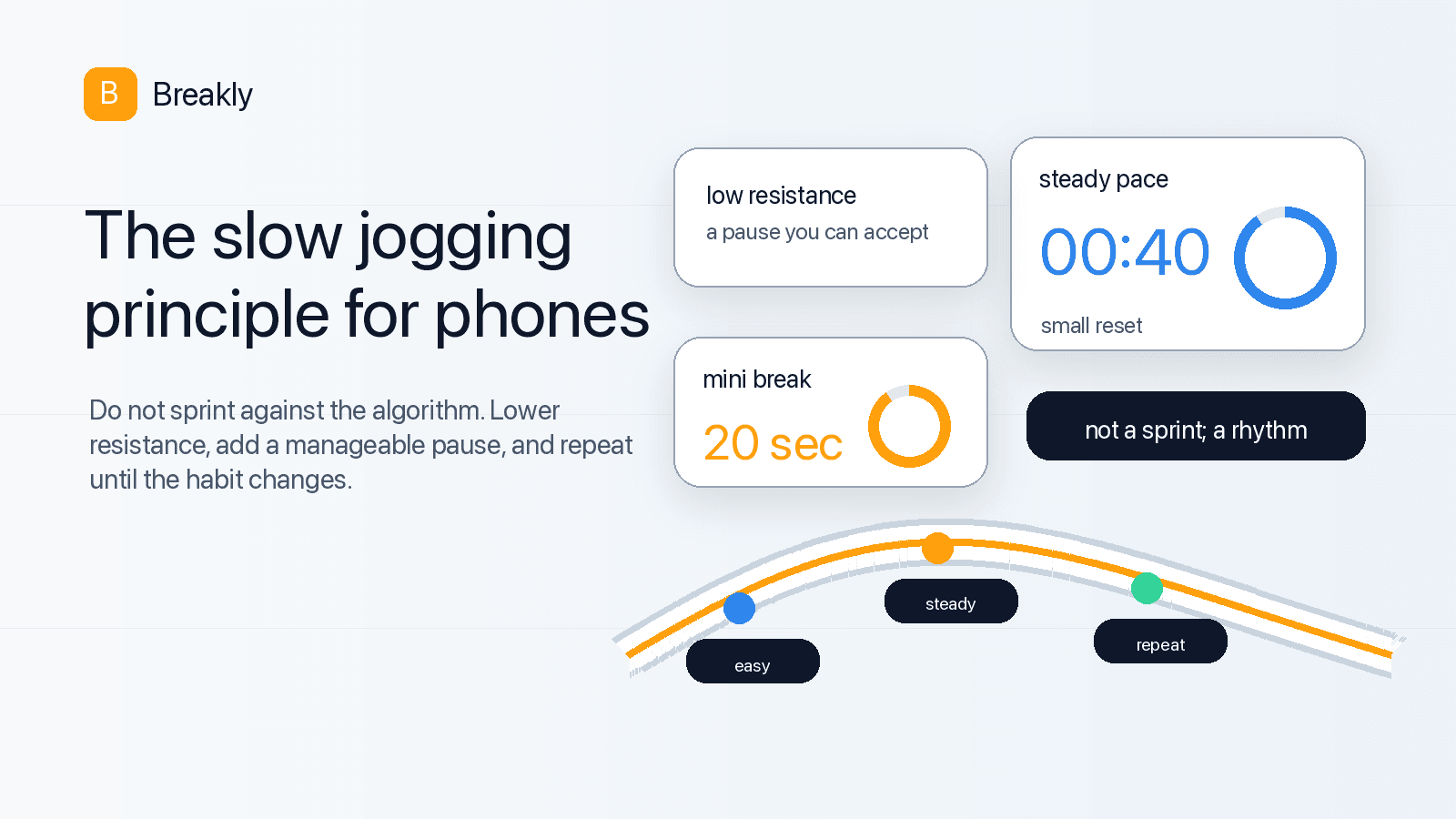
The "Slow Jogging" Philosophy
To find the answer, we have to look outside the digital world and turn to physical exercise, specifically running.
If you sprint at your absolute maximum effort from the very first step, you will burn out in minutes, despise the experience, and likely quit altogether. But sports science and behavioral psychology consistently show that the secret to building endurance and forming a lasting habit is slow jogging. By running at a comfortable, conversational pace, you minimize physical pain and mental resistance. You last longer, and over time, it becomes effortless.
A randomized controlled trial on a 12-week low-intensity slow-jogging program found that it was easy for older adults to perform and improved aerobic capacity, muscle function, and muscle composition (Ikenaga et al., 2016). The important lesson is not only physical fitness. It is that a low-resistance pace can make repeated effort sustainable.
We need to apply this exact same philosophy to our digital habits.
First, we must humbly admit a hard truth: our raw willpower will never defeat a billion-dollar algorithm. Second, we must stop using harsh, aggressive interruptions to force ourselves off our phones. Sudden, permanent lockouts only trigger our "fight or flight" response, causing immediate frustration and a rebellious urge to disable the restriction.
Enter Breakly: The Science of the "Pause"
This is where Breakly takes a fundamentally different approach. Instead of rigid bans, it uses an alternating "Short Pause and Long Pause" system, enforced by a Strict Mode that prevents you from disabling it mid-session.
Here is how it works and why it effectively rewires your brain:
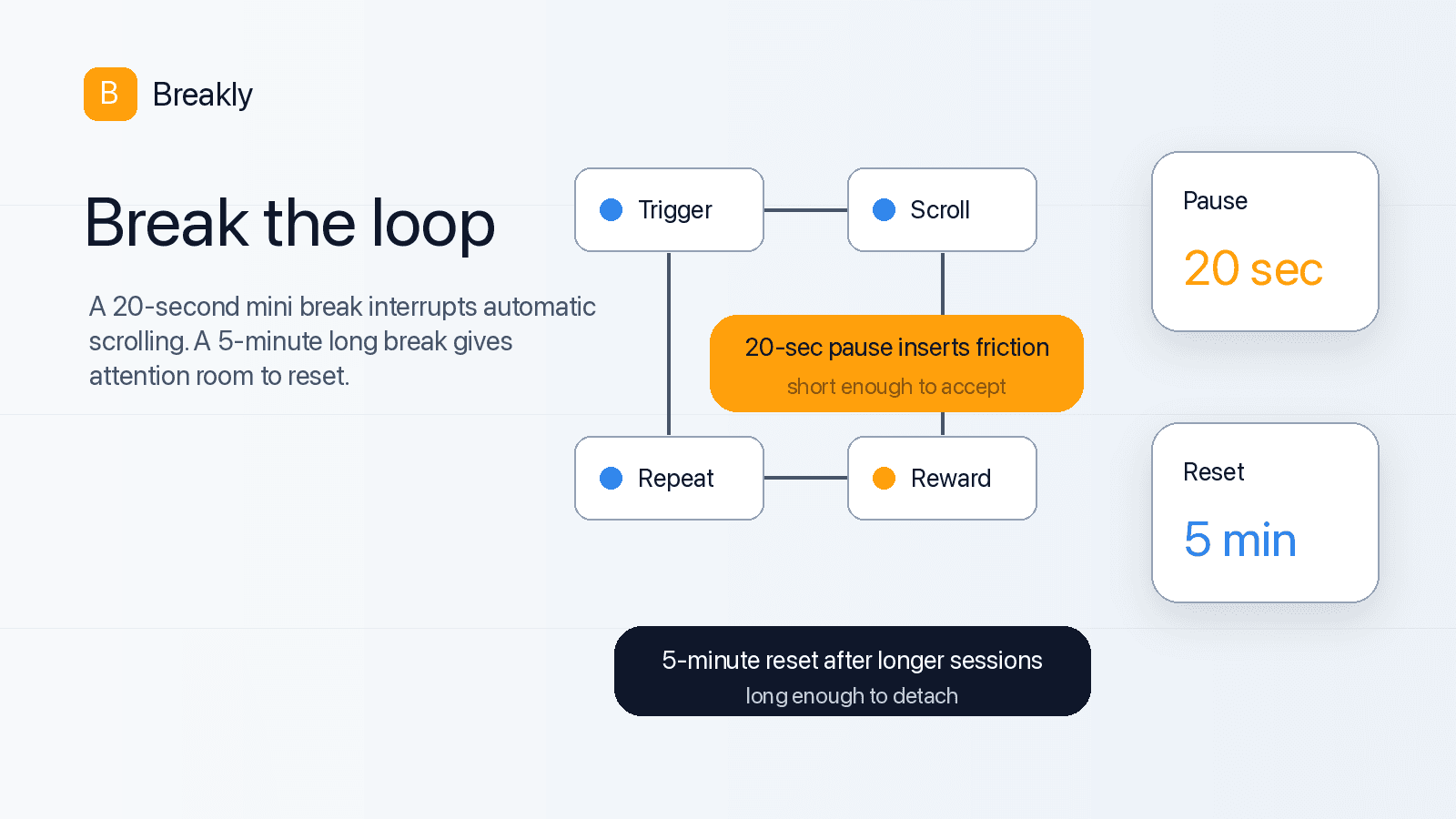
The 20-Second Short Pause: Every 20 minutes, Breakly initiates a strict 20-second pause. Why only 20 seconds? Because it is incredibly short. It doesn't trigger the psychological resistance or anger that a hard lockout does. You won't feel the urge to fight the app or find a way to disable it because waiting 20 seconds is practically effortless.
The Magic in the Timing: A typical short video lasts between 15 to 30 seconds. Your brain has grown accustomed to receiving a dopamine hit at exactly that rhythm. A 20-second pause is precisely long enough to interrupt that specific reward loop, diluting the artificial pleasure and pulling you out of the algorithmic trance.
Micro-break research points in the same direction: a 2022 meta-analysis found that short breaks can support well-being and reduce fatigue, especially when the break is brief enough to be accepted rather than resisted (Albulescu et al., 2022).
The 5-Minute Long Pause: If you slip back into scrolling, the system triggers a 5-minute pause at the 60-minute mark. Because you have already experienced (and failed to stop during) the gentle nudges of the short pauses, this longer break naturally induces a mild sense of accountability and guilt.
A Gentle Reset: More importantly, 5 minutes is the perfect amount of time to fully detach from the screen's dopamine drip. Yet, it still feels manageable. You aren't being told, "You are banned from your phone for the day." You are simply being told, "Let's rest for 5 minutes."
There is also early evidence that adding a short moment of friction before opening an app can help. A field study of the one sec app found that a self-nudge intervention reduced social media opening attempts by forcing a brief pause before the target app opened (Gruening, Riedel, and Lorenz-Spreen, 2023). Breakly uses a related idea, but focuses on scheduled, enforceable breaks rather than a single open-app prompt.
Rebuilding Your Willpower
Breakly's genius lies in its profound understanding of human nature. By not entirely prohibiting you from viewing content, it entirely removes the friction and hostility associated with digital detoxing.
It breaks the rhythm of addiction using intervals that are carefully calibrated to be annoying enough to wake you up, but painless enough to accept. Just like slow jogging, it doesn't demand perfect discipline from day one. Instead, it gently paces you, helping you rebuild your self-control, 20 seconds at a time.
This matters most at night. A systematic review and meta-analysis in JAMA Pediatrics found that bedtime access to or use of portable screen-based media devices was associated with inadequate sleep quantity, poor sleep quality, and excessive daytime sleepiness (Carter et al., 2016). Breaking the loop is not just about productivity. It is also about protecting the next morning.
References and Further Reading
Oulasvirta, A., Rattenbury, T., Ma, L., and Raita, E. (2012). Habits make smartphone use more pervasive. Personal and Ubiquitous Computing. https://link.springer.com/article/10.1007/s00779-011-0412-2
Carter, B., Rees, P., Hale, L., Bhattacharjee, D., and Paradkar, M. S. (2016). Association Between Portable Screen-Based Media Device Access or Use and Sleep Outcomes: A Systematic Review and Meta-analysis. JAMA Pediatrics. https://pubmed.ncbi.nlm.nih.gov/27802500/
Ikenaga, M., Yamada, Y., Kose, Y., Morimura, K., Higaki, Y., Kiyonaga, A., and Tanaka, H. (2016). Effects of a 12-week, short-interval, intermittent, low-intensity, slow-jogging program on skeletal muscle, fat infiltration, and fitness in older adults: randomized controlled trial. https://pubmed.ncbi.nlm.nih.gov/27848017/
Albulescu, P., Macsinga, I., Rusu, A., Sulea, C., Bodnaru, A., and Tulbure, B. T. (2022). Give me a break! A systematic review and meta-analysis on the efficacy of micro-breaks for increasing well-being and performance. PLOS ONE. https://journals.plos.org/plosone/article?id=10.1371/journal.pone.0272460
Rogers, T., Milkman, K. L., and Volpp, K. G. (2014). Commitment devices: using initiatives to change behavior. JAMA. https://jamanetwork.com/journals/jama/fullarticle/1866163
Gruening, D. J., Riedel, F., and Lorenz-Spreen, P. (2023). Directing smartphone use through the self-nudge app one sec. Proceedings of the National Academy of Sciences. https://pmc.ncbi.nlm.nih.gov/articles/PMC9974409/
常見問題
Is Breakly just another screen time limiter?
No. Breakly focuses on enforceable pauses. The short pause is intentionally easy to accept, while Strict Mode prevents casual disabling during the session.
Why does Breakly use a 20-second pause?
The pause is short enough to avoid strong resistance, but long enough to interrupt the rapid reward rhythm of short-video feeds.
Why connect slow jogging with phone habits?
Slow jogging works because it lowers resistance and builds endurance gradually. Breakly applies the same idea to digital habits by using small, repeatable pauses instead of harsh lockouts.
試試強制休息
Breakly 讓你先排好休息時間,Strict Mode 開始後會持續擋住選定的 iPhone App。
前往 App Store 下載